
Tracking branded FMCG products across channels relies on standardized GTINs and EAN barcodes. Direct SKU mapping is straightforward.
However, cross-retailer benchmarking breaks down when dealing with two critical areas: e-commerce product matching without unique identifiers and Private Label (Own Brand) price tracking. In competitive markets like the UK and Continental Europe, mastering both is essential to protect market share and secure margins.

Technical Challenges of Non-EAN Product Matching
Product matching links identical or directly substitutable SKUs across different sales channels. When EANs are missing, internal, or intentionally masked by competitors to prevent web scraping, traditional extraction tools fail.
To prevent mispriced matches, enterprise-grade retail data platforms evaluate multiple weak signals to reconcile product catalogues:
-
Semantic similarity: Cross-referencing titles, product descriptions, and category taxonomy.
-
Attribute normalization: Converting units and formats (e.g., mapping 75cl to 0.75L or normalizing multi-packs).
-
Computer Vision: Matching pack graphics and shelf presentations despite variations in image angles or lighting.
Key Takeaway: Poor matching algorithms lead to high false-positive rates (e.g., matching a single item against a 6-pack). Implementing advanced
Private Label Benchmarking: UK & European Market Dynamics
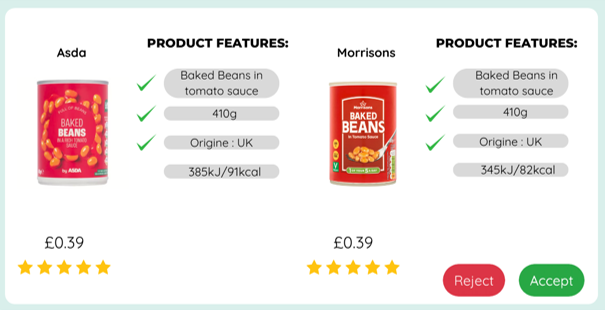
In the UK, price competition between traditional grocers (Tesco, Sainsbury’s, Asda) and discounters (Aldi, Lidl) hinges on Own Brand ranges and aggressive “Price Match” campaigns.
Benchmarking Private Label products,from fresh food to ambient groceries, requires navigating several technical hurdles:
-
No shared EANs: Every retailer operates on internal item codes.
-
Pack size variations: Ingredients, packaging, and net weights differ (e.g., comparing a 400g item with a 500g variant).
-
Tier alignment: Products must be matched across equivalent tiers (Entry-level / Value, Core, Premium / Finest) for benchmarks to deliver meaningful insights.
Manual matching across thousands of Private Label SKUs is slow, costly, and prone to human error. Modern
Automate Matching to Drive Category Performance
Managing Private Label pricing and non-EAN product matching through manual audits or static spreadsheets is no longer viable. To execute precise pricing strategies across the UK and European markets, retail teams require automated matching engines designed for the realities of modern retail data.