
Price monitoring and pricing management: compare, simulate, decide
Track your position against competitors, prepare your pricing rules and compare scenarios before making a decision.
Retail Shake matches comparable products and brings together the data you need for your analysis. From price indices to simulations of revenue, unit sales and margins, your teams have a shared basis for making pricing decisions.


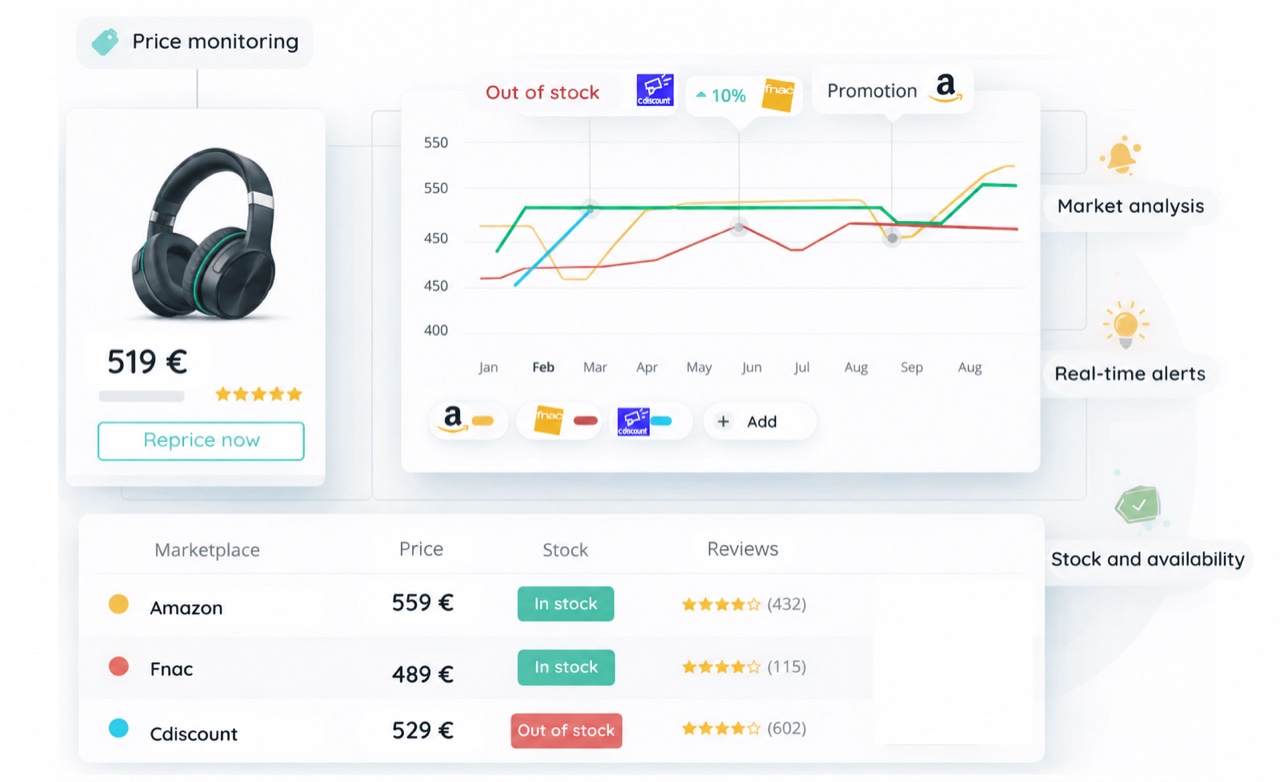
From market monitoring to pricing decisions
Track your price indices and trends. Identify differences in positioning by product, category or competitor and see how they change over time.
Prepare your pricing rules. Set your positioning objectives, margin constraints and exceptions for your assortment.
Compare pricing scenarios. Test different price changes and see how your elasticity assumptions affect estimated sales volumes.
Assess the impact before deciding. Compare estimated effects on revenue, unit sales and margins using your chosen data and assumptions. You stay in control of the prices you apply.

Market monitoring that fits your business
You are a
BRAND
Track how retailers and marketplaces offer your products.
You are a
RETAILER
Compare your assortment with competing offers, even when brands and product references differ.
Start with the decisions you need to make
Which categories should you monitor? Which competitors should you compare? What balance are you looking for between price positioning, sales volumes and margins?
At Retail Shake, we start with your products and the decisions you need to prepare. Together, we define the comparison criteria, the data you need and the assumptions to test.
You know your market. Our team helps you make the most of the tool.
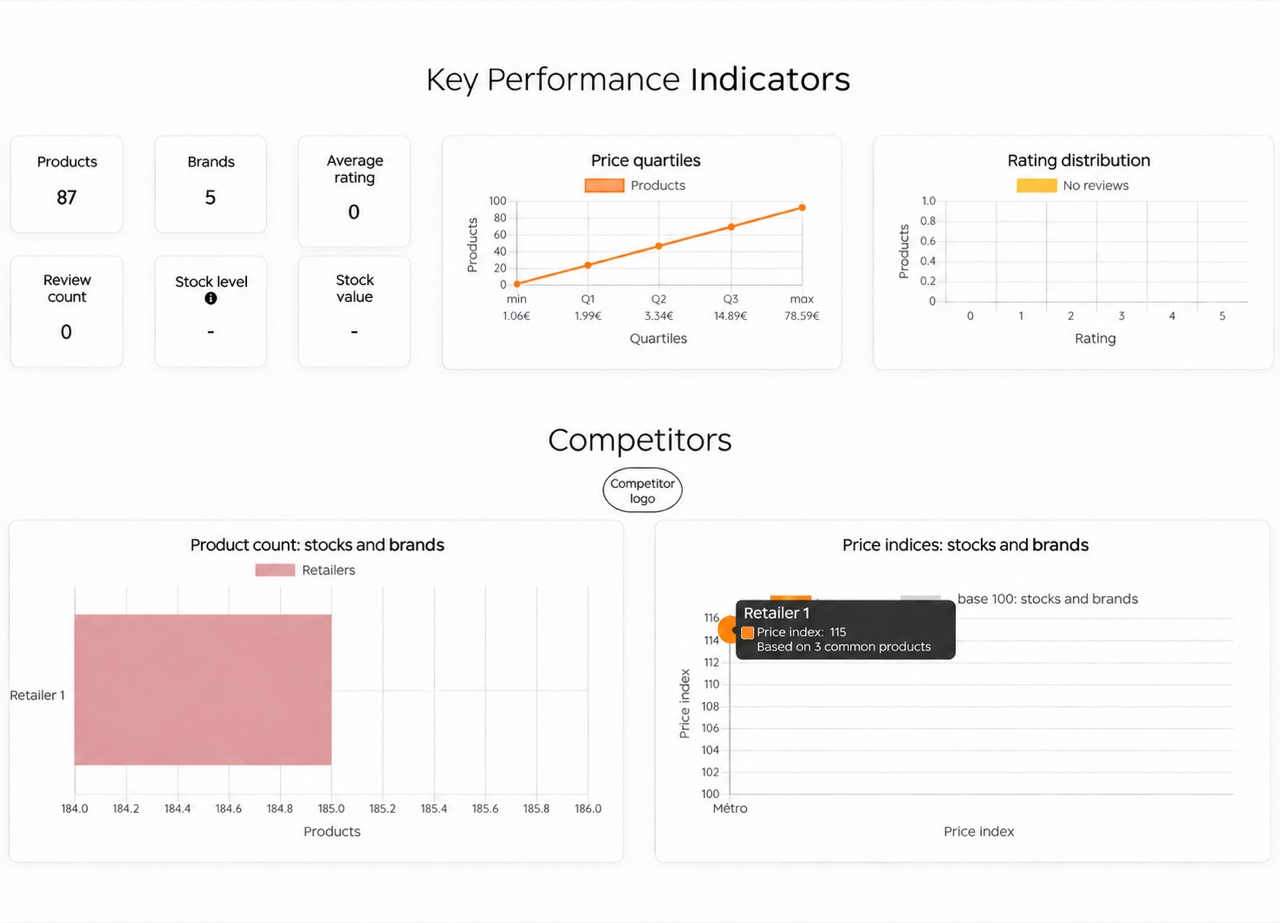
Three steps to prepare your pricing decisions
1
Observe
Compare the right products, track your price indices and spot changes in your market.
2
Simulate
Test your pricing rules and scenarios. Compare estimated effects on revenue, unit sales and margins.
3
Decide
Review the results, adjust your assumptions and assess exceptions. You stay in control of the prices you choose.
Different categories call for different product attributes
You would not compare two washing machines in the same way as two pieces of furniture or two bags of pet food.
Capacity, dimensions, material or composition: the criteria depend on the products. Retail Shake combines product attributes and images to suggest matches that your teams can review and validate.

Price monitoring

Price comparison

Product matching

Review collection

Retail data for AI

Product categories

Stock monitoring

Price change alerts
They use Retail Shake to monitor their markets
Data quality starts with the right questions
Does a lower price refer to the same product? The same quantity? Is the offer available? When was it observed?
This context makes comparisons meaningful. We define the criteria that matter to you, then review an initial sample together before extending the monitoring scope.
Our supporters


Our labels


Let’s look at your catalogue together
Choose a category and a few competitors. We show you how to compare offers, read your price positioning and prepare a first pricing scenario.
Follow our updates


Frequently asked questions
What is price monitoring?
Price monitoring means tracking competitors’ offer prices over time. To understand differences, you also need to consider the products being compared, promotions, availability and sales terms.
Can you compare products from different brands?
Yes, by defining the attributes that matter for the category. Retail Shake suggests matches for review; your teams decide which ones to use in their analysis.
Where should we start?
With one category, a few competitors and a sample of products. Together, we check the matches and the data you need before extending the scope.
Compare products and competing offers
How should we interpret a pricing simulation?
A simulation estimates a scenario’s effects on revenue, unit sales and margins. Its results depend on sales data, costs and the assumptions used. Here, elasticity is an assumption about how sales volumes respond to a price change; simulated impacts are not guaranteed results.