
Product matching: compare offers beyond product codes
Compare your catalogue with competing offers, even when brands, names and product codes differ. Retail Shake uses product attributes and images to help identify relevant alternatives. Your teams review the differences and approve matches against their business criteria.
Build a comparison base for purchasing, assortment and pricing decisions.
From appliances to pet food, adapt your matching criteria to each category.

From catalogues to useful comparisons

Combine product attributes and images
Attributes describe dimensions, performance, composition or pack size. Images complement this information when appearance matters to the product choice.
By combining these details, your teams can review competing alternatives even without a shared product reference.
Product matching across your categories
Two examples show how to define comparison criteria, identify differences and decide which matches to retain.
Appliances: comparing two 9 kg washing machines
In this proposal, the VALBERG from Electro Dépôt and the IM964MYTIMEFR model sold by But share a 9 kg capacity, energy class A and a maximum spin speed of 1,400 rpm. Both are front-loading washing machines without a tumble-dryer function.
The comparison also highlights a repairability difference: 8.5 versus 7.9. Competitor width is missing and needs checking before it can inform the decision.
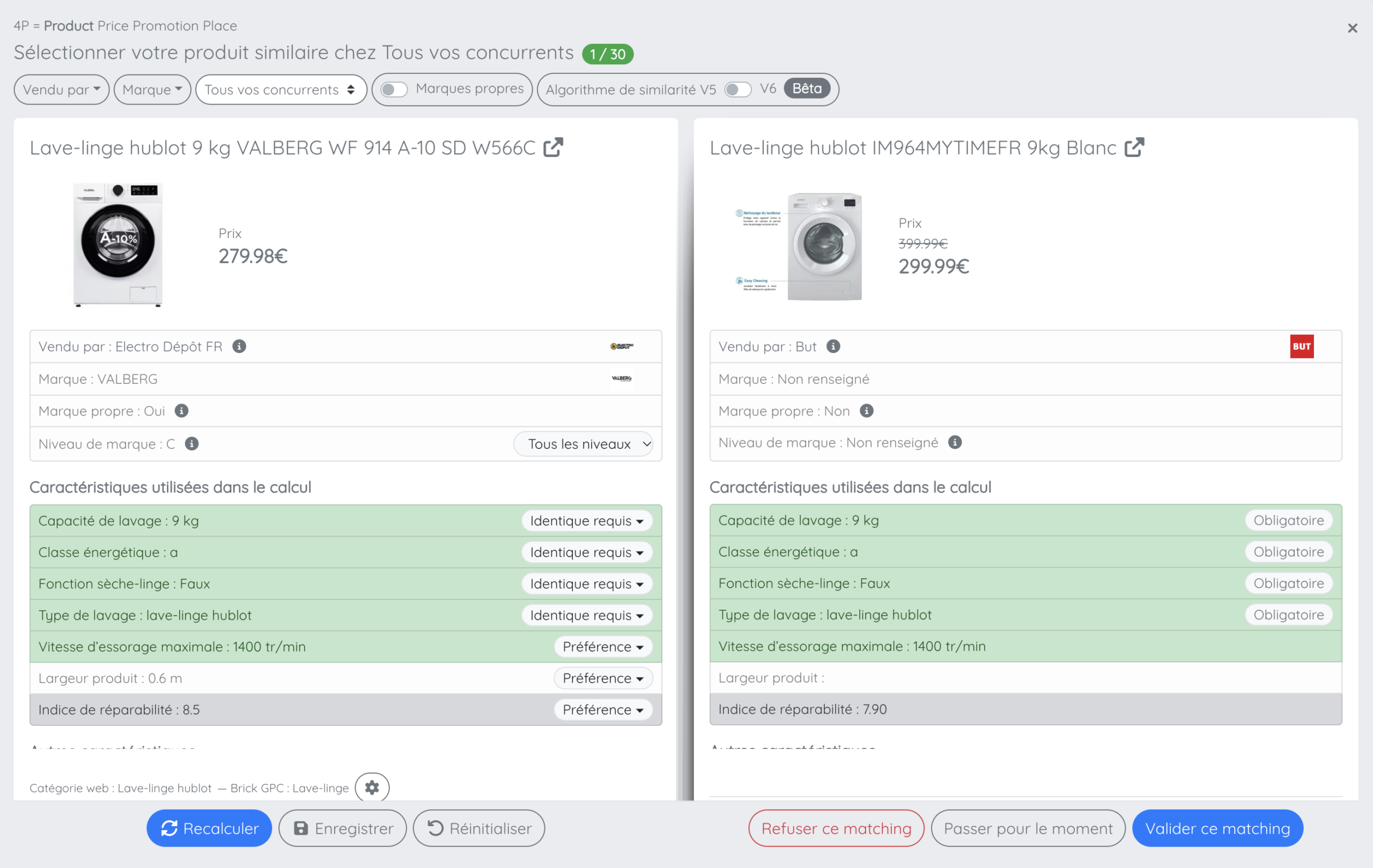
Compare washing machine specifications and review the differences before approving a match.
Pet food: comparing dry cat food across brands
TRUFFY from Truffaut and TRUE ORIGINS from Animalis are proposed for comparison using a 2 kg pack size, dry food type and an intended use for adult sterilised cats.
Your teams can then refine the comparison: competitor flavour is missing and its name includes a “Hairball” function. These differences require review before accepting the match.
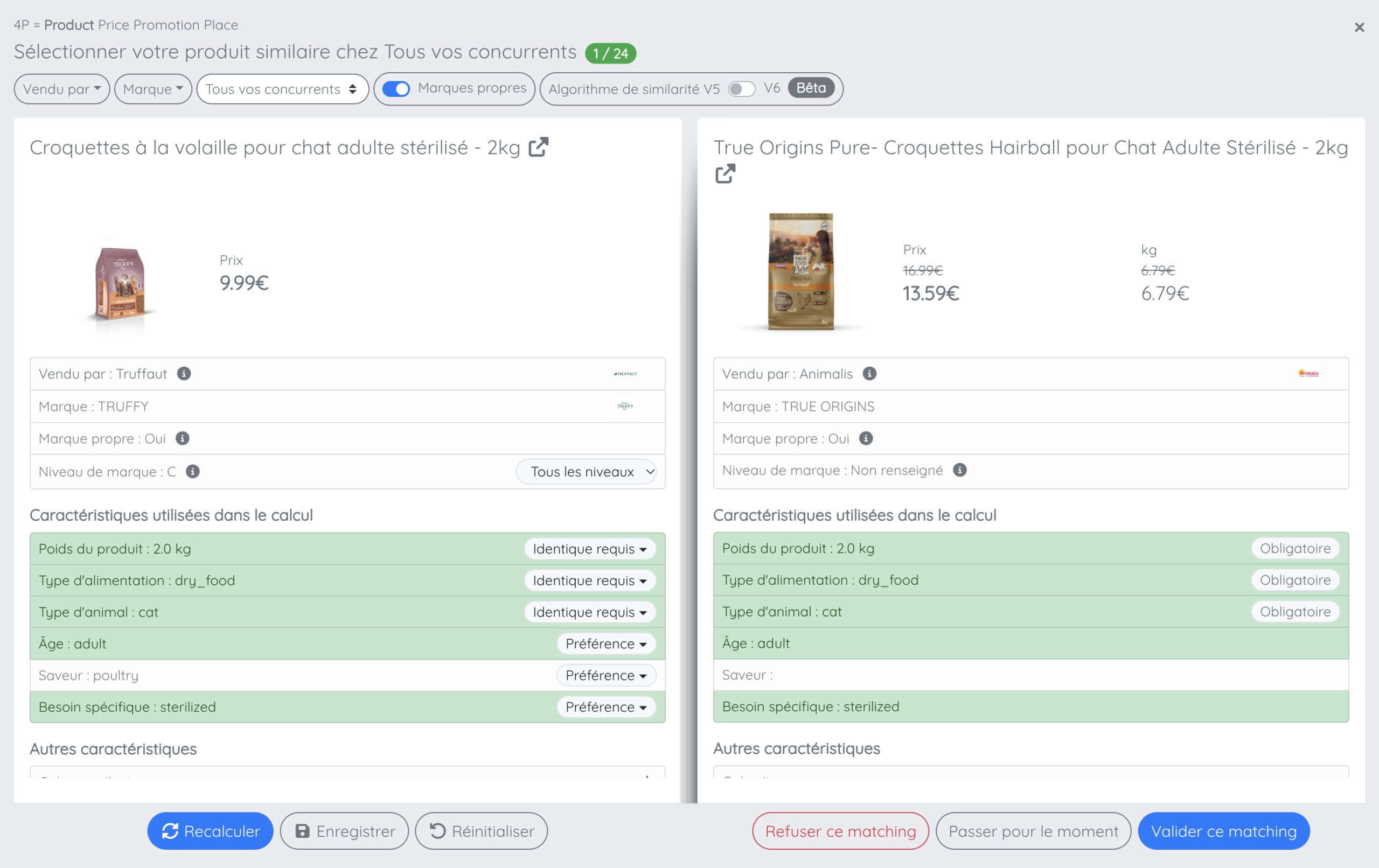
Compare cat food across brands using pack size, food type and the cat’s needs.
Stay in control of product matching
Define your category’s comparison rules and retain the final decision on proposed matches.
1. Define the criteria
Choose which attributes are essential and which are preferences: capacity, material, format, performance or intended use.
Adapt the rules to your products and the decisions you want to support.
2. Compare the data
Review matched values, units and images. Identify common attributes, differences and missing information.
The same capacity can be expressed in litres or millilitres; a material difference can change the intended use.
3. Approve the matches
Accept or reject proposals against your business criteria. Retain the differences that help explain subsequent price gaps.
Missing data remains a point to check.
Your objective: build a defined scope of comparable products for competitor analysis.
Focus on the relevant offers
Target offers that matter to your market:
- the retailers and sellers to monitor;
- brands, including private labels;
- categories and product attributes;
- the price range;
- marketplace offers, according to your scope.
Distinguish identical products, similar products and alternatives from other brands.


Monitor offers after approving matches
Once matches are retained, track prices, promotions and the availability of competing offers within the agreed scope.
Differences in attributes, sellers and sales conditions help explain the gaps you observe.
Support assortment and pricing decisions
Identify market alternatives, review your price positioning and track availability changes.
Purchasing, category and pricing teams share a comparison base to decide which products and offers to monitor.
Let’s discuss your catalogue
Product matching: frequently asked questions
How does EAN matching differ from attribute matching?
A shared EAN helps identify the same product reference. Attributes help review products with different brands or references against criteria such as format, capacity or material.
What role do images play?
They help identify similarities and review style or appearance. Visual similarity, including the Picture Score, does not by itself guarantee equivalence.
Can private-label products be compared?
Yes, by defining essential category criteria and reviewing differences between offers. Your teams approve matches suited to their intended use.
Evaluate matching on your assortment
Choose a category, a few competitors and a representative product sample: shared references, private labels and alternatives from different brands.
Review relevant proposals, differences and products without results. This test helps refine the criteria and scope before extending monitoring.